Dune Awakening Map Guide: Deep Desert, Regions & Key Locations
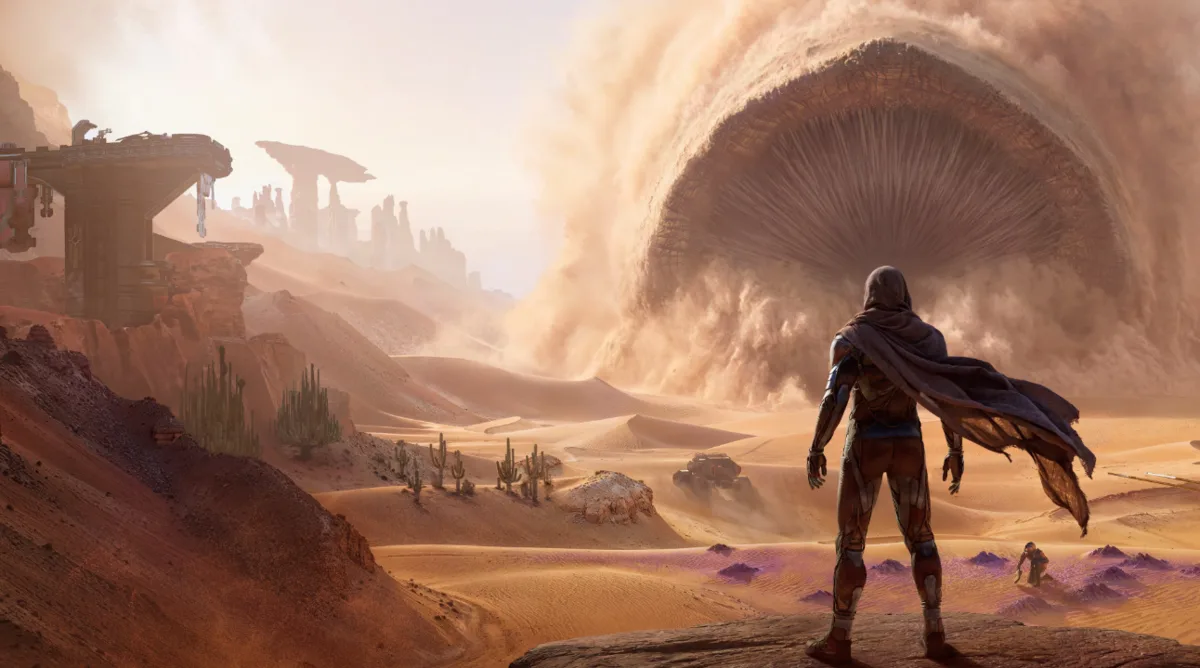
The Dune Awakening map is much larger and more layered than a single open-world zone. Your journey starts in Hagga Basin, then expands through the Overland Map to social hubs, unique mission locations, and the dangerous Deep Desert. By 2026, Funcom has also added several new overland destinations and separate PvE and PvP Deep Desert options on official Worlds.
If you are new to Arrakis, the most important thing to understand is that each map serves a different purpose. Hagga Basin is your persistent survival home, the Overland Map connects major destinations, and the Deep Desert is the high-value endgame zone. This guide explains how the current map works, where the main regions are, how to reveal locations, and what changed in 2026.
Table of Contents
Dune Awakening Map at a Glance
| Area | Main Purpose | What to Expect |
|---|---|---|
| Hagga Basin | Main survival map | Base building, exploration, resources, quests, multiple biomes |
| Overland Map | Travel network | Connects major regions, hubs, missions, and special locations |
| Deep Desert | Endgame exploration | High-value resources, spice, testing stations, PvE/PvP instances |
| Arrakeen | Social hub | Faction activity, services, story content |
| Harko Village | Social hub | Services, faction content, player activity |
| Unique Overland Locations | Missions and exploration | Tsimpo, Wind Pass, Old Quarry, Smuggler’s Run, and more |
1. Hagga Basin Is Your Main Survival Map
The Dune Awakening map begins with Hagga Basin, a huge depression protected from the worst of Arrakis’ Coriolis storms by its geography and the Shield Wall. It is the persistent region where players spend much of their early and mid-game time surviving, gathering resources, building bases, and learning how the desert works.
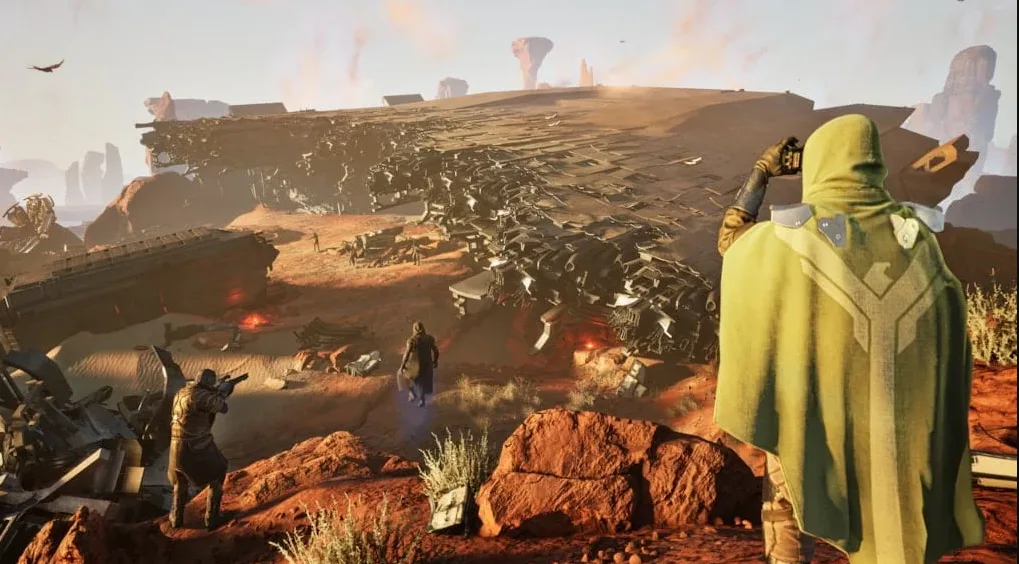
Hagga Basin contains several very different environments rather than one endless stretch of sand. Official material highlights places such as the iron-rich Vermillius Gap, the deep Hagga Rift, the comparatively greener O’odham region, and the irradiated Seol area.
Unlike temporary endgame zones, Hagga Basin is designed to feel like your home territory. This makes it the best place to learn water management, vehicle travel, resource routes, and safe movement before pushing deeper into Arrakis.
If you enjoy survival progression and base-building systems, you may also want to read our Valheim Beginner Guide 2026 for another survival-focused progression guide.
2. The Overland Map Connects Arrakis
The Dune Awakening map is divided into multiple separate regions, and the Overland Map acts as the travel layer between them. Instead of physically driving or flying across every kilometer of Arrakis, you use the Overland Map to move between major destinations.
As the game has expanded, this travel layer has become more important. Chapter 3 and later updates improved the Overland Map with better markers, location categories, party indicators, and clearer mission information. Funcom also removed fuel and hydration costs from Overland Map travel, making long-distance movement easier to manage.
The Overland Map now includes a growing list of special destinations, including:
- Smuggler’s Run
- Blushing Caverns
- Wreck of Tyche
- The Broodworks
- Ruins of Tsimpo
- Wind Pass
- The Old Quarry Testing Station
- Old Carthag
- Wreck of Hephaestus
Many of these locations are tied to Landsraad missions, faction progression, repeatable activities, or story content, so the Overland Map becomes increasingly valuable as you progress.
3. How to Reveal the Dune Awakening Map
Exploration does not automatically reveal every point of interest. One of the core Dune Awakening map mechanics is surveying.
The official map-making overview explains that players can climb to high vantage points and launch Survey Probes. A probe scans part of the surrounding area and reveals terrain along with important locations.
This means high ground is not just useful for spotting enemies. Survey locations help you build a clearer picture of the region before spending time or fuel exploring every path manually.
Players who train in the Planetologist progression can also learn the Cartographer skill. This supports map creation through Sinkcharts, which can record uncovered regions and be shared or traded. In the September 2026 single-player update, the Cartographer skill was also adjusted to increase the player’s Fog of War reveal radius.
4. The Deep Desert Is the Endgame Map
The Deep Desert is the most dangerous and strategically important part of the Dune Awakening map. You typically reach it after obtaining an ornithopter and becoming strong enough to handle much greater environmental and combat risks.
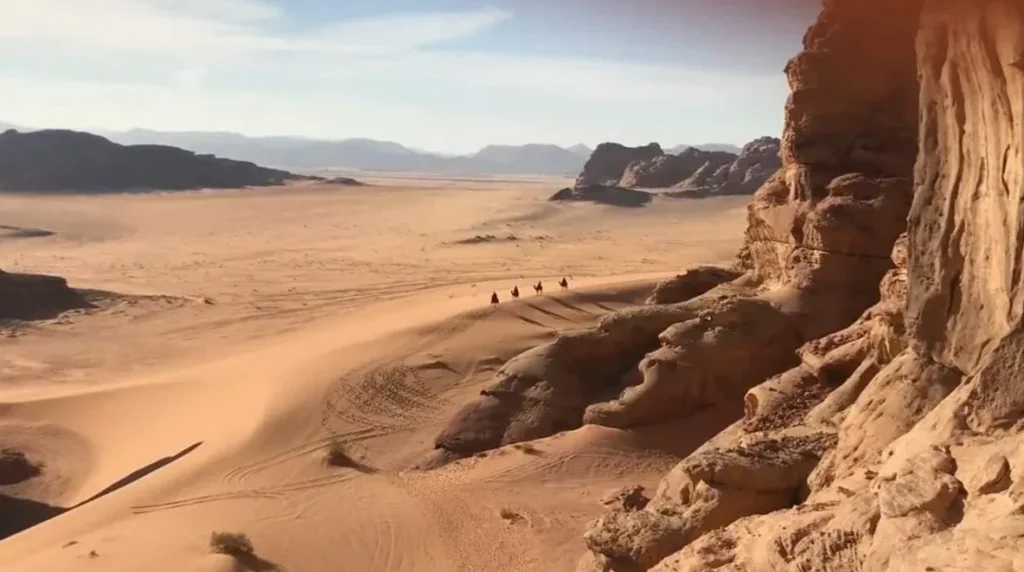
This region contains valuable resources, spice activity, testing stations, and other endgame opportunities. It is also much less forgiving than Hagga Basin, so arriving with weak equipment or poor preparation can quickly become expensive.
The Deep Desert was originally closely associated with PvP, but this changed significantly in 2026. Funcom introduced separate PvE and PvP Deep Desert instances on official Worlds. The PvE version removes player-versus-player combat, while the PvP version keeps higher-risk conflict and offers increased resource yields in its PvP areas.
That change makes the Deep Desert much more accessible to players who want endgame exploration and progression without being forced into open-world PvP.
5. Does the Deep Desert Map Reset?
This depends on how you are playing.
In the traditional online experience, the Deep Desert is shaped by the Coriolis cycle. Funcom’s original design uses powerful storms to change the landscape, bury old resources and points of interest, and reveal new ones. This prevents the Dune Awakening map from becoming completely static.
However, the new single-player experience introduced in September 2026 works differently. In single-player, the Deep Desert remains fully available, but the map does not reset, and player buildings are not wiped. The Coriolis Storm still exists as a dangerous weather event, but it no longer destroys the map in the same way.
This is a major difference between online and solo progression, so always consider your game mode before planning long-term Deep Desert construction or resource routes.
6. PvE and PvP Deep Desert Instances
One of the biggest 2026 changes to the Dune Awakening map is the ability to choose between PvE-first and PvP-focused Deep Desert experiences on official Worlds.
The PvE instance is designed for survival, exploration, and progression without player combat. Funcom states that PvP is disabled throughout this version of the Deep Desert, including areas that were previously high-risk conflict zones.
The PvP instance keeps open-world conflict and adds extra incentive for players who deliberately choose that risk. Mining and spice harvesting yields are increased in PvP areas, making the dangerous option potentially more profitable.
For new players, PvE is the safer place to learn routes, resource locations, and testing stations. Once you understand the terrain and can afford to lose equipment, the PvP instance becomes a more reasonable option.
7. Important Overland Locations Added in 2026
The current Dune Awakening map is noticeably larger than it was at launch. Chapter 3 and subsequent patches expanded the Overland Map with several new destinations.
Ruins of Tsimpo
Tsimpo was added as a ruined settlement accessible through the Overland Map. It includes repeatable Landsraad missions and a deliberately hostile, dust-filled atmosphere.
Wind Pass
Wind Pass arrived with Update 1.4. The location was once a Harkonnen technology hub and later became important to Arrakis’ water trade under the Water Shippers. It also includes new Landsraad missions.
The Old Quarry Testing Station
The Old Quarry is another Update 1.4 destination. It contains a scalable Testing Station and a confrontation with Dr. Jalanta inside a hidden laboratory.
Smuggler’s Run and Blushing Caverns
These areas were added as smaller but distinct Overland Map locations. Smuggler’s Run is built around a challenging route suitable for ground vehicles, while Blushing Caverns features bandit activity around a large erythrite cave.
Because Funcom continues adding destinations, older launch-day maps and guides may not show every location now available in 2026.
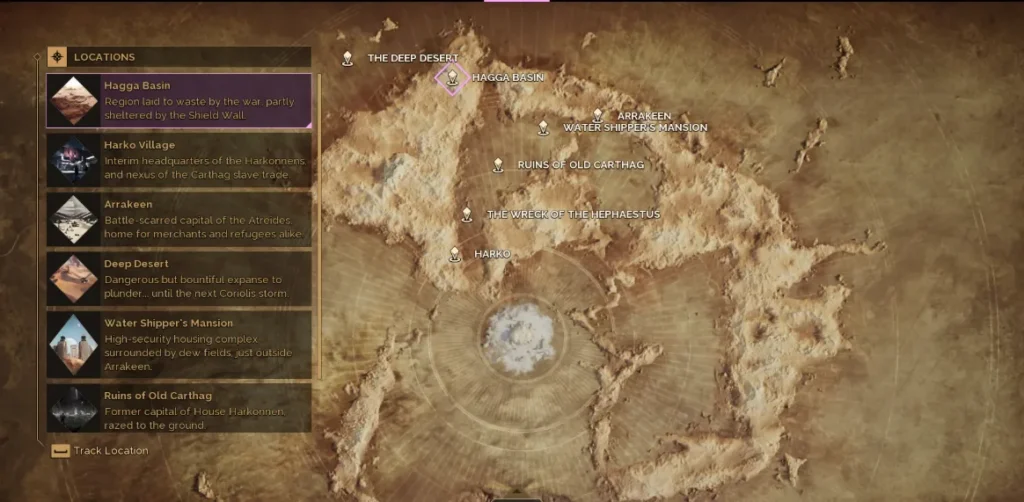
8. Arrakeen and Harko Village
Arrakeen and Harko Village are major social and faction hubs rather than traditional survival regions. They connect players with important services, story content, and faction systems.
They are worth visiting regularly as your progression opens new activities. The September 2026 single-player implementation also allows both hubs to be visited, with systems adjusted to function without other human players.
9. Best Map Tips for New Players
Understanding the Dune Awakening map is more important than trying to memorize every icon immediately. These habits will make exploration much easier:
- Use Survey Probes whenever you reach a strong vantage point.
- Unlock travel and map knowledge before chasing distant resources.
- Learn Hagga Basin first before treating the Deep Desert as your main farming zone.
- Use an ornithopter for long-range exploration once available.
- Check whether you are entering a PvE or PvP Deep Desert instance.
- Do not rely on old Deep Desert routes forever because Coriolis conditions can change the landscape in online play.
- Track Landsraad missions because the Overland Map can highlight their relevant destinations.
- Use map markers and party markers when exploring with other players.
For more general combat-focused advice, our SPRAWL Zero Beginner Guide covers movement, combat resources, and early-game decision-making. If you prefer action RPG progression, see our Onimusha: Way of the Sword Beginner Guide.
10. Is There One Complete Dune Awakening Map?
Not really. It is better to think of Arrakis as a network of connected maps rather than one seamless world. Hagga Basin is a major persistent open-world region, the Deep Desert is a separate endgame space, and the Overland Map connects these with social hubs and unique mission locations.
This structure also allows Funcom to keep expanding the game without forcing every new location into Hagga Basin. The official 2026 roadmap has already expanded Arrakis substantially, and Funcom has also teased a future Polar Cap survival map with new mechanics.
Frequently Asked Questions
What is the main Dune Awakening map?
Hagga Basin is the main persistent survival map where players begin, build bases, gather resources, and complete a large amount of progression content.
How do you reveal the map in Dune Awakening?
Reach high vantage points and launch Survey Probes to scan terrain and reveal important locations. Planetologist progression can further improve map-related abilities.
Where is the Deep Desert?
The Deep Desert is a separate endgame region accessed through the wider travel structure of Arrakis once your progression and vehicles allow it.
Is the Deep Desert PvP only?
No. Official Worlds now provide separate PvE and PvP Deep Desert instances, so players can choose whether they want player combat.
Does the Deep Desert reset every week?
The online experience uses the Coriolis cycle to reshape and reset Deep Desert progression. In the September 2026 single-player mode, the Deep Desert map does not reset, and buildings are not wiped.
Can you visit Arrakeen and Harko Village?
Yes. Both are major destinations in the wider Arrakis map structure and are available in the current game, including the 2026 single-player experience.
Final Thoughts
The Dune Awakening map makes more sense once you stop treating Arrakis as one giant continuous zone. Hagga Basin is your persistent survival home, the Overland Map connects major destinations, and the Deep Desert provides the dangerous endgame layer.
With new locations, improved Overland Map tools, optional PvP in the Deep Desert, and a different reset system for single-player, many older map explanations are now incomplete. Learning how these regions connect will save time, reduce unnecessary risk, and make resource progression much easier.
For more new-release and survival guides, you can also read our Blood of Dawnwalker Beginner Guide.
Official Sources
- Dune: Awakening — Universe of Dune
- Dune: Awakening — Game Updates
- Developer Update — April 2026
- Dune: Awakening Update 1.4 Patch Notes
Share this content:






1 comment